
Vol 82, no 10, October 2026
Human beings are endowed by our Creator with natural rights, which are inalienable—not subject to repeal. They do not depend on the Civil Rights Act of 1964 or the U.S. Supreme Court. They include the right to life, liberty, and property. They are negative rights: human beings have the right not to be murdered, enslaved, or robbed. But they have no right to demand that others supply them with medical care, food, housing, esteem, or desired service. Enforcing such a demand would deny others their rights.
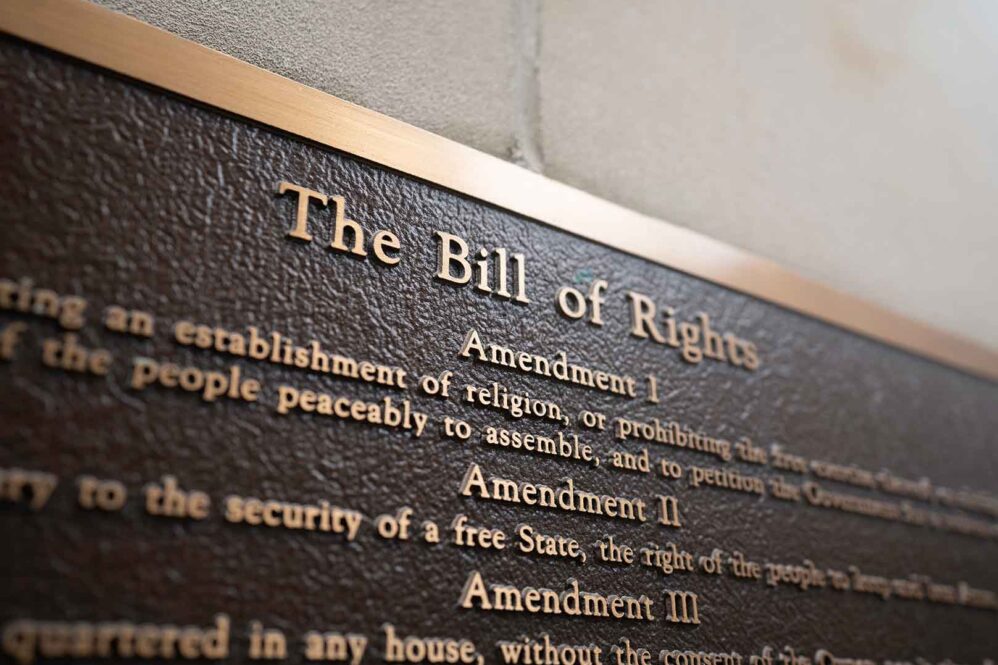
The first 10 amendments to the Constitution were intended to protect the people against the federal government’s violation of their natural rights and to assure due process in criminal law.
Slavery, the most egregious violation of the rights to life and liberty, was once considered a private property right, enforced by government, as in returning fugitive slaves. It was outlawed in 1865 by the 13th Amendment: “Neither slavery nor involuntary servitude, except as a punishment for crime whereof the party shall have been duly convicted, shall exist within the United States, or any place subject to their jurisdiction.”
Federal rights were extended to State law by the 14th Amendment (see p 3). Importantly, rights apply to persons, not just citizens (https://tinyurl.com/55294azj).
While protecting individuals from abusive state governments, the 14th Amendment, by dismantling the structural barrier between State and federal authority, established a permanent constitutional pathway through which the federal government, in later expansions of its authority, could supervise the internal law of every state (https://tinyurl.com/vxb6dh5h).
The “Exception Clause” in the 13th Amendment permitted “convict leasing,” so that freed slaves, imprisoned on minor offenses, were leased to railways, mines, and plantations. This practice largely ended in the 1930s, but as recently as 2010, a federal court held that “prisoners have no enforceable right to be paid for their work under the Constitution” (tinyurl.com/39z2r7tt). Many prisoners now work for pennies a day; for example, in a federal prison factory that produced bags for the military.
The U.S. Supreme Court has ruled that military conscription (the draft) does not violate the 13th Amendment because compulsory military service is a fundamental duty owed to the state rather than a form of involuntary servitude. Congress is granted broad constitutional power to raise and regulate armies and navies (https://tinyurl.com/yc2dwau5).
Might physicians have a duty to serve the state? In response to a shortage of physicians in remote ERs, Quebec health boards had the authority to dispatch a bailiff to awaken a doctor and order him to relocate as far as 500 km on 15 hours’ notice (AAPS News, November 2002). Could this happen in the U.S.?
There’s the “Anti-Dumping” Act, the Emergency Medical Treatment and Active Labor Act of 1986 (EMTALA), part of the Consolidated Omnibus Budget Reconciliation Act of 1986 (COBRA), signed by President Reagan. This requires hospitals contracted with Medicare that have an emergency department to provide whatever services are necessary to stabilize any patient, regardless of ability to pay. In July 2026, Merit Health Central Hospital in Jackson, MS, entered into a $350,000 settlement agreement because of alleged inadequate screening and treatment prior to transfer of patients with psychiatric symptoms or penetrating injuries in 2013 or 2015 (tinyurl.com/3y94tw23).
Hospitals require physicians to voluntarily accept the liability for such patients as a condition of medical staff privileges. An on-call specialist who fails to appear in person within a reasonable timeframe when requested can face personal civil monetary fines exceeding $100,000 per violation. This unfunded mandate results in frequent lack of on-call specialists.
Slaves were punished for not working. Doctors may be fined, but they are not slaves—they are (so far) not required to practice medicine or to be on a hospital staff. Providing care is an ethical duty, [not an obligation to an owner], and EMTALA is “patient protection,” according to the American College of Emergency Physicians. ACEP states that more than one-third of emergency physicians provide more than 30 hours of EMTALA-related care each week and that 55% of an emergency physician’s time is spent providing uncompensated care (https://tinyurl.com/32ahjazu).
More physicians (still <2%) are opting out of Medicare. Only about 71% of office-based physicians accept Medicaid, and perhaps 28% of those are “ghost providers,” who treat no beneficiaries (https://tinyurl.com/3rvt9v5s). So far, American physicians, unlike Canadians, can still treat self-pay patients; the Clinton plan that would have outlawed this failed. However, escaping the managed-care treadmill and opening subscription-based practices may be called “ethically indefensible.”
“The very existence of VIP services allows for multiple tiers of care along racial and socioeconomic lines, thereby reinforcing patterns of racism and classism,” states the AMA Journal of Ethics (https://tinyurl.com/3ba7v8ar). It might even violate the principle of nonmaleficence because it could cause harm to patients by draining the system of qualified physicians who care for the majority of Americans. “Justice demands that resources be equitably distributed” (https://tinyurl.com/mr3vcm3c).
Natural rights are being subjugated to safety and social justice, and to newly defined “rights” such as abortion, physician-assisted death, and transgender treatments. Was this situation enabled by the Civil Rights Act (see pp 2-3)?
Persons cannot be held as chattel slaves, but do they have the right to refuse medical treatments they consider harmful, to speak and to hear non-government-approved ideas, and to refrain from engaging in or promoting behavior contrary to conscience?
Freedom of Association
Does the right to liberty include freedom of association? This logically also means freedom to exclude or not to associate.
Libertarians view freedom of association to be one of our most important rights. Barry Goldwater and Walter Block, for example, opposed the Civil Rights Act of 1964 because it went beyond banning “Jim Crow” laws that required racial segregation in schools and public conveyances to forbidding private businesses that offered “public accommodations” to choose their clientele or employees on the basis of race, religion, or national origin.
Many favored the law to protect against depredations such as beating white people for purchasing gasoline at a black-owned filling station or serving black customers at a lunch counter.
The notable exception to the favorable consensus was Robert Bork, who in August 1963 wrote a scathing critique of Title II in The New Republic on the ground that it offended the basic principle of freedom of association: “The legislature would inform a substantial body of the citizenry that in order to continue to carry on the trades in which they are established they must deal with and serve persons with whom they do not wish to associate. In part the willingness to overlook that loss of freedom arises from the feeling that it is irrational to choose associates on the basis of racial characteristics. Behind that judgment, however, lies an unexpressed natural-law view that some personal preferences are rational, that others are irrational, and that a majority may impose on a minority its scale of preferences.” Although Bork tried to distance himself from this piece, it helped doom his 1987 nomination to the U.S. Supreme Court (R Epstein, Stanford Law Rev (tinyurl.com/m6wyf49j).
Firms that exert monopoly power over certain markets, which include the usual forms of public transportation, Epstein argues, differ from doctors, lawyers, plumbers, hair stylists, and a thousand other occupations that should not be under antidiscrimination law.
The current situation is topsy-turvy, he states. State-mandated nondiscrimination is being imposed over a wide range of business and social institutions that lack monopoly power, and on powerless individuals, and is a threat to the diversity of our private institutions.
The reach of the antidiscrimination law has expanded enormously, and more “suspect classes” have been added to those deserving [more] Equal Protection. Florists, bakers, photographers, caterers, and even religious organizations can be forced to provide services against their will, even in violation of religious beliefs. Is the Constitution’s Faustian accommodation of slavery consuming the Constitution itself (https://tinyurl.com/yf2sn25u)?
Freedom of Association for Patients and Doctors
Doctors enrolled in Medicare are forced to discriminate and deny certain services to patients who are enrolled in Medicare—or to forgo remunerative payment. For example, doctors will only get 50% payment if a separately payable service is rendered at the same visit (Modifier 25). Thus, patients are inconvenienced by the need for another visit. In three days, nine influencers posted a message thanking Dr. Oz for cutting waste and shutting down “robbery” (https://tinyurl.com/2zxybek7).
“Prior to capitalism, the way people amassed great wealth was by looting, plundering and enslaving their fellow man. Capitalism made it possible to become wealthy by serving your fellow man.”
Walter Williams
ACTION OF THE MONTH
Does your practice welcome direct-pay patients? Please make sure you are on our list to help patients find you: aaps.pub/listing.
HHS Launches Vaccine Injury Research
The U.S. Department of Health and Human Services (HHS) has launched actions to “strengthen how the federal government identifies, documents, investigates, and responds to health problems reported following vaccination, with a focus on improving patient care and generating better evidence about potential vaccine-related injuries,” according to an HHS press release (https://tinyurl.com/z5wn6ytb).
A ribbon-cutting ceremony for a new clinic on the NIH campus dedicated to studying and caring for patients experiencing health problems following vaccination was held Oct 5, but the website has no details on making referrals. CMS proposes a reimbursement policy to reduce barriers to physician reporting and encourage documentation of suspected adverse events following vaccination. So far, no CPT code or details.
An article in Science (9/15/26) notes: “There are a lot of very sick people out there.” But it cautioned: “If it’s not done in a scientific way it will be more antivaccine propaganda.”
Proposed studies include where the mRNA encoding spike protein goes in the body, how long cells continue to produce spike protein, and the mRNA’s specific effects on human physiology (https://tinyurl.com/32n8jdm7). Apparently, these were not done before administering billions of doses. Is HHS admitting that the key parts of data that are required for biologics licensing don’t exist (https://tinyurl.com/44zd553b)?
“Vaccine injury is an invisible disease, and it is purposefully invisible,” HHS Secretary Kennedy said during the clinic’s opening. “For many years, moms and children with vaccine injuries, the parents of those children, people who suffered injuries themselves have been marginalized, vilified, demonized, and gaslighted, and they have not received the medical attention they need, and we have not done the studies that need to be done to understand who’s vulnerable to those kind of injuries.”
NIH Director Jay Bhattacharya, Centers for Medicare & Medicaid Services (CMS) Administrator Dr. Mehmet Oz, and Centers for Disease Control and Prevention (CDC) Director Dr. Erica Schwartz joined Kennedy at the opening.
Dr. Oz observed a “recurring theme” as they talked to the patients at the clinic: that “the doctors taking care of them both ignored their symptoms, but also did not report what the families, especially the parents, thought had happened to their children.”
Veteran pediatrician Dr. Elizabeth Mumford stated that she has heard the stories of the vaccine-injured “a thousand times.” She said that her attempt to address vaccine safety with leadership of the American Academy of Pediatrics (AAP)—which receives large donations from pharmaceutical companies—was “dismissed.” Her own observations—confirmed by independent data mining—was that under‑vaccinated children had lower rates of chronic diseases (Lumen News 10/8/26, https://tinyurl.com/srx5pjrc).
AAPS Calendar
Feb 6, 2027. Board of Directors meeting by Zoom.
Sep 16-18, 2027. 84th Annual Meeting, Cincinnati, OH.
Constitutionality of the Civil Rights Act of 1964
In a landmark 8–1 decision known as the Civil Rights Cases, the U.S Supreme Court declared the Civil Rights Act of 1875 unconstitutional, as Congress had exceeded its Constitutional authority. However, in Heart of Atlanta Motel v. United States, 379 U.S. 241 (1964), the Supreme Court noted that, unlike earlier acts, the 1964 Act limited the categories of affected businesses to those impinging upon interstate commerce. Racial discrimination had an undeniable effect on commerce, the Court held. Moreover, Congress’s power extended to intrastate activities that affect interstate commerce if regulation of them was an appropriate means to the attainment of a legitimate end (tinyurl.com/mrzz4m5j).
The Court found no merit in the 5th Amendment claim that the Act is a taking of property without just compensation, or in the 13th Amendment claim of involuntary servitude. Forced nondiscrimination is not “akin to African slavery.”
Katzenbach v. McClung, 379 U.S. 294 (1964), concerned restaurants that, even if local, served food that had moved in interstate commerce. The Court held that racial discrimination at restaurants that receive a substantial portion of the food served from out of state does, in fact, impose commercial burdens of national magnitude upon interstate commerce. Citing the critical precedent of Wickard v. Filburn, 317 U. S. 111 (1942), the Court held that it didn’t matter that the amount of food bought by Ollie’s Barbecue was insignificant compared with total foodstuffs moving in commerce. “It was representative of many others throughout the country, the total incidence of which, if left unchecked, may well become far-reaching in its harm to commerce.” Moreover, “it cannot be maintained that the exertion of federal power must await the disruption of that commerce. Congress was entitled to provide reasonable preventive measures” (tinyurl.com/xtz7c5ec).
In the case that enabled the explosion in federal regulation, Roscoe Filburn was a farmer who grew more wheat than the 200 bushels that were exempt under the Agricultural Adjustment Act of 1938. He exceeded his quota of 233 bushels by about 240. He withheld this for future sale or used it to feed livestock, which was unregulated when sold. Feeding regulated wheat to unregulated livestock destined for market would allow farmers to evade the quota system, and in the aggregate such activities could substantially affect interstate commerce. Although its reversal could bring instant economic recovery, Robert Bork wrote that the Wickard decision is “too thoroughly embedded in our national life to overrule” (AAPS News, September 2013, https://tinyurl.com/y8eddvns).
Theft of the Constitution?
Ianto Watt, who has a beautifully illumined copy of the U.S. Constitution on his wall, asks whether this document still actually exists—or died aborning in 1803 (https://tinyurl.com/53sx55pc).
In his view, the Constitution did NOT contemplate or define a government of three co-equal branches. The most important part is Congress, which has the power to override the executive and regulate the judiciary.
In what is considered the single most important decision in American constitutional law, Marbury v. Madison (1803), Chief Justice John Marshall asserted the right of the Supreme Court to nullify laws. Thus, the case of denial of a not timely delivered commission to serve as a justice of the peace led to a “judicial coup” making five or more judges the supreme rulers of the U.S.
The 14th ‘Incorporation’ Amendment
Justice Clarence Thomas is the only modern Supreme Court Justice to challenge incorporation, writes Richard Greenhorn. The 14th Amendment’s purpose was to refute the holding in Dred Scott that blacks (and former slaves) were not “citizens” of the U.S. (https://tinyurl.com/2bcjbfyc).
In his uncharacteristically lengthy dissent in Trump v. Barbara (https://tinyurl.com/4bbxb9sv), Justice Thomas writes: “Blacks were entitled to citizenship because they were Americans. They had no other homeland, owed no allegiance to any foreign power, and were subject to no other authority…. The same could not be said for the children of foreign temporary visitors.”
He notes that this Court selectively enforces our colorblind Constitution. And the Court has “repurposed the 14th Amendment to protect its own set of preferred rights that the Reconstruction Congress never contemplated.”
The Incorporation Clause is quite vague: “No State shall make or enforce any law which shall abridge the privileges or immunities of citizens of the United States.”
It does not specify the Bill of Rights. The Court did not include the 2nd Amendment until 2010, Greenhorn notes, and still hasn’t included other parts of the other amendments, like the grand jury requirement of the Fifth—it only includes what it likes.
AAPS Files Amicus in Sports Gambling Case
AAPS has filed an amicus brief in a petition for the U.S. Supreme Court to grant writ of certiorari in Flaherty v. KalshiEX.
Online sports gambling is an addiction as harmful as the opioid crisis, AAPS argues, citing former U.S. Surgeon General Jerome Adams. He observed that gambling is “the addiction most likely to lead to suicide” and stated that “[t]wo to 4 million Americans may experience gambling disorder in their lifetime.” An estimated 52% of men aged 18-49 have an active online sportsbook account, and 46% of men report that they actually place wagers. Advertising for online gambling is ubiquitous. It brazenly circumvents state prohibitions to promote the equivalent of sports gambling on everyone’s handheld cell phone, by reinterpreting an old statute that cannot plausibly be read to federalize sports gambling (https://tinyurl.com/y2pbe824).
Tip of the Month. At our recent annual meeting in Georgia, our General Counsel urged that no one resign medical staff privileges while under investigation (or in exchange for not conducting an investigation). Such resignations are immediately reported by hospitals to the National Practitioner Data Bank, where it will never be removed. In addition, a physician loses rights by resigning. After our meeting, we learned of a third reason not to resign while under investigation: some hospitals have inserted a credentialing requirement that the applicant never have resigned privileges while under investigation. These hospitals refuse to consider an application for medical staff privileges by such physicians, even if the resignation was due to a sham peer review.
Here’s a set of bylaws publicly available online (not the one confidentially forwarded to us) that has this “no prior resignation” requirement: https://tinyurl.com/yk63xz25. It denies an application if the applicant “has resigned while under investigation or to avoid an investigation of an alleged professional misconduct or to avoid the imposition of disciplinary measures.”
Correspondence
No Equality under the Law. “Qualified immunity” enables those who trample on individual rights under the impression that they are outside the bounds of the law. It is particularly egregious under the Health Care Quality Improvement Act. HCQIA presumes that a hospital has complied with due process requirements in peer review and then shifts the burden to accused physicians to prove otherwise by a preponderance of the evidence. The result is that accused physicians are guilty unless and until you can prove your innocence by a preponderance of the evidence.
Lawrence R. Huntoon, M.D., Ph.D., Eden, N.Y.
Taking Back the Words. For 50 years, the left has pulled off the greatest intellectual heist in modern history—with words, as in Orwell’s 1984. “Progressivism” is anti-progress wanting to punish those who build. The word says “forward”; the project says “backward.” “Antiracism” has reinjected race everywhere. It assigns people to their color, locks them into boxes, pits groups against each other. The crusades “against homophobia” tense things up, they divide, they impose—and in turn create part of the rejection they claimed to want to extinguish. But there’s one thing Newspeak hadn’t accounted for. A semantic inversion doesn’t survive the precise moment when people see it plain as day. We’re taking back the words. We’re taking back reality.
Brivael le Pogam, https://tinyurl.com/yc8psrd9
Without Property Rights…. The Aral Sea, which once covered 68,000 square kilometers, became bone dry because Soviet planners diverted rivers to meet a quota for growing cotton. Most of the water evaporated before reaching a single plant. Water had no price, and no owner. A fishery that employed 40,000 people was thus destroyed. During Mao’s Great Leap Forward, peasants were ordered to kill every sparrow. Without insect-eating sparrows, locust swarms stripped the crops, and 30 million people starved in 1958–1962. “Everyone” owned the land; no one was accountable.
Handre, https://tinyurl.com/48uvmyh6
Semantics: a Deadly Misdiagnosis. The West treats Islam as a religion, a set of private beliefs, rituals, and moral teachings that can be accommodated within the liberal nation-state much like Christianity, Judaism, or Buddhism. Western thought developed powerful tools for managing religion after the wars of religion: privatize belief, separate church from state, tolerate private conscience while demanding public loyalty to the civic order. These tools worked on Christianity because Christianity had already generated internal resources (two kingdoms doctrine, natural law, Reformation pluralism) that permitted compartmentalization.
Islam functions as a state—not in the narrow Westphalian sense of a territorially bounded sovereign entity, but as a transnational state, a borderless political community with its own constitution and expansionist logic. In Islam, there is no compartmentalization. Its foundational texts fuse the religious and political in a single revelation claimed to be final and perfect.
The existence of secular reformers, or vocal “Muslims against Islam,” does not erase the doctrinal and historical reality of Islam as a conquering, occupying force. Successful defense would require: treating the Ummah-state as a strategic competitor rather than a faith community in need of inclusion, rigorous enforcement of host law, ideological competition, and an unapologetic defense of the nation-state as the legitimate container of political loyalty.
Dan Buramawi, https://tinyurl.com/y63mr9kk
AI Will Never Become Superintelligence. If computer models—also called AI—pose any threat, and they surely can, it is because computer models can be put to evil use by bad people. Electronic computers are different from wooden abacuses by degree only, and not by kind. The speed at which a computer operates has no bearing on the states of its switches (unless there is a malfunction). Thus, a computer clicking its clock once per day is the same as one clicking it billions of times a second: the only difference is speed. While the slow-clock collection of transistors would not be claimed to be alive, the fast-clock one might be. But computers are different from minds. Computer states are discrete, and it is we who assign va;ues to these states. Our minds are instead in continuous space, which computers can only imperfectly approximate. Some of our thought, that which makes us rational beings, is itself not material, and does not happen in matter.
William Briggs, Ph.D., https://tinyurl.com/3nexypm5
Reality Always Collects. Every mistake and lie gets paid for. Sooner or later, in full. The only questions are when and who pays. A good society makes the person who is wrong pay. A bad system protects the person who is wrong. It postpones the bill and passes it on. And the bill grows, and arrives later, much larger, at the door of someone who did nothing. The children. The poor. The next generation. Sometimes an entire country. A lie is a loan taken out against reality. You borrow comfort today; someone else repays it tomorrow, with interest. What our civilization built, slowly, over centuries, is ways of making the bill reach the right address. The market, where a price tells the truth. Science, where the experiment decides. Courts and free elections, where even the powerful can be removed. Free speech, where anyone can point at the mistake. The family, where parents live with the results. The good news: we have a real chance to switch—from a society built on fear and lies to one built on truth. That is why some people are suddenly so nervous.
Krzysztof Szczawinski, https://tinyurl.com/j2jfm4f2